
As businesses grow, hiring becomes one of the most important decisions to get right. Many companies struggle to decide between permanent staffing and contract staffing or contingent staffing, especially when they are expanding quickly and need clarity.
In the staffing industry, both permanent staffing and contract staffing serve different purposes. The challenge is not choosing one over the other but understanding which one fits your current business need. Understanding how perm staffing and temporary staffing fit into India’s changing workforce landscape can help businesses make smarter hiring decisions that support long-term growth.
What Contract Staffing and Permanent Staffing Mean in India’s New Regulatory Age
Permanent staffing refers to hiring employees on a permanent or full-time basis under formal employment contracts. In India, such employment structures are governed through labour frameworks including the Industrial Employment (Standing Orders) Act, 1946, and the Code on Social Security, 2020, which was introduced to streamline employee benefits and social security compliance across sectors.
Within the staffing industry, permanent staffing is considered a structured workforce model that supports long-term business continuity, organisational stability, and workforce retention. Companies generally rely on permanent staffing for roles that require deeper operational involvement, process ownership, and long-term alignment with business goals.
Employees hired under permanent staffing models typically become more familiar with company processes, internal systems, customer expectations, and organisational culture over time. This makes permanent staffing suitable for functions where consistency, accountability, and long-term workforce development are important.
Contract staffing refers to hiring employees for a fixed duration, usually through a staffing partner or third-party workforce provider. In India, this model has traditionally operated under the Contract Labour (Regulation and Abolition) Act, 1970, which was introduced to regulate the employment of contract labour and ensure compliance related to working conditions, wages, and welfare measures.
Temporary staffing is particularly useful for project-based requirements e.g. seasonal workforce expansion, market entry initiatives, and specialised short-term roles where businesses require agility without immediately increasing permanent headcount.
Over the years, temporary staffing has become a widely adopted workforce strategy across industries such as retail, manufacturing, logistics, telecom, technology, and customer support because it allows businesses to scale operations based on project timelines and market demand. This shift is also reflected in recent workforce trends.
Under this model, staffing partners generally manage responsibilities such as recruitment, onboarding, payroll processing, statutory compliance, attendance management, and workforce administration. This enables businesses to improve workforce flexibility while reducing administrative complexity.
Choosing the Right Model in a Changing Compliance Environment
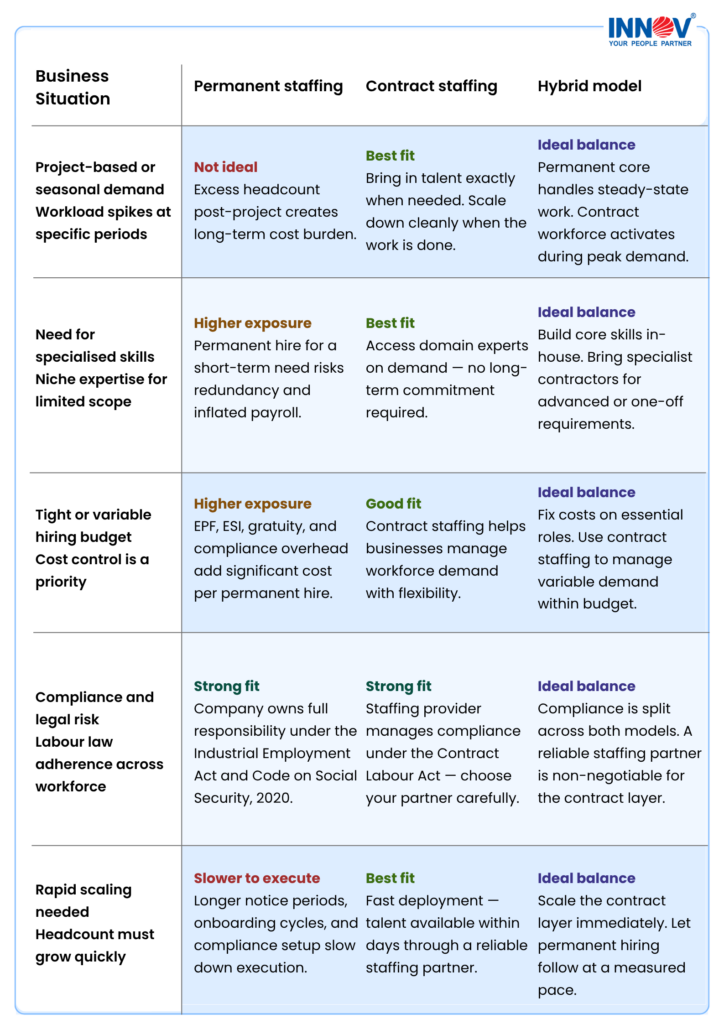
Businesses today are no longer looking at hiring through a single lens. As workforce regulations evolve and market demands change faster, companies are increasingly evaluating whether permanent staffing, contract staffing, or a mix of both is the right fit for their operations. The decision now depends on factors such as workforce stability, scalability, compliance responsibilities, project timelines, and long-term business goals.
As hiring strategies continue to evolve in India, many organisations are now adopting hybrid workforce models that combine permanent staffing for core operations with contingent staffing for flexibility and speed. This approach allows businesses to balance workforce stability with changing operational demands while maintaining compliance and cost efficiency.
If you are looking to build a strong long-term team or need quick support for growing business demands, choosing the right staffing model can make all the difference. Because every business has different workforce needs and you can find the right staffing approach for your business with our experts.
Perm staffing and contingent staffing are not competing options. They serve different purposes, and the right choice depends on what your business needs right now and what it is working toward.
If you are building a core team that stays, grows, and takes ownership of your operations, permanent staffing gives you that stability. If you need to ramp up quickly for a project, a season, or a new market, contract staffing lets you do that without long-term commitments.
For most businesses, the real answer lies in knowing when to use each. Many companies today use permanent staffing for their core functions and contract staffing where they need speed and flexibility. This way, they get the best of both without overextending on either side.
The right staffing model is the one that matches where your business is today, not a fixed formula.
Your Next Smart Hiring Move
Hiring decisions can shape the future of your business. Choosing between full-time staffing and temporary staffing is not always easy, especially in a fast-moving staffing industry.
At Innovsource, we help businesses understand their hiring needs and choose the right staffing model. Whether you need permanent staffing, contract staffing, or a mix of both, we can support your growth with the right talent solutions.
Connect with Innovsource today and build a workforce that fits your business goals.